Thermomechanical study via piercing indentation SThM in C/BN heteronanotubes buckypapers
- Abstract number
- 405
- Presentation Form
- Contributed Talk
- DOI
- 10.22443/rms.mmc2023.405
- Corresponding Email
- [email protected]
- Session
- Nanoscale Probing of Physical Properties via AFM & SPM
- Authors
- Sergio Gonzalez-Munoz (1), Ruth S. Jones (2), Dr. Barbara Maciejewska (2), Prof. Nicole Grobert (2), Prof. Oleg V. Kolosov (1)
- Affiliations
-
1. Lancaster University
2. University of Oxford
- Keywords
Thermomechanical, pSThM, buckypaper, boron nitride, carbon, nanotubes
- Abstract text
When it comes to nano-composite fabrication, buckypapers (BPs) can be an appropriate alternative due to their convenient mechanical properties. Their paper-like thin-film structures possess high flexibility and low weight, which makes it ideal for their incorporation in nanoscale devices. Despite this, the focused research in this field has been towards carbon nanotubes (CNTs) films, leaving an open paradigm for its boron nitride nanotubes (BNNTs) electrically insulating counterpart.
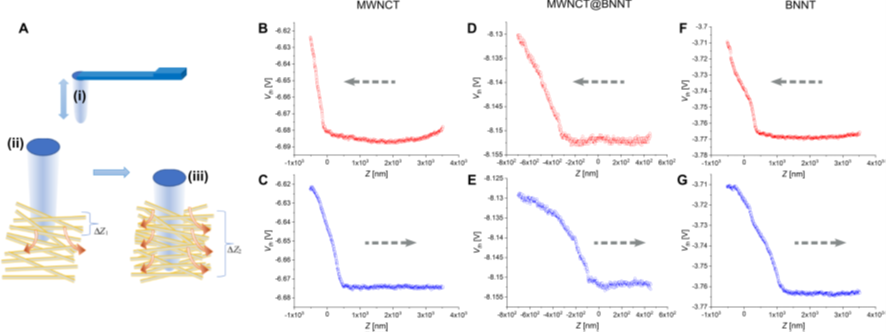
Here, we investigate the thermal properties of pristine CNTs, BNNTs and their combined CNT/BNNT-composite BPs also by giving an insight to their relationship with their mechanical features. We use a novel method of piercing Scanning Thermal Microscopy (pSThM), which provides a simpler and more precise characterization environment than other techniques that have to make use of additional structures due to the high porosity and softness of the BPs. This technique measures the heat conductance from the sharp SThM tip to the sample as a function of the tip-sample penetration, ultimately quantifying the thermal conductivity and the mechanical nature of the measured thin films.
The combination of the two types of nanotubes coaxially in the studied composite proves its worth by improving its thermal and chemical stability, since the addition of the higher thermally conductive BNNTs provides further pathways for heat transport in the nanotube direction. Specifically, a 14% increase in the thermal conductivity is observed comparing the composite BP with the reference CNTs BP. Also, given its high mechanical strength and negligible electrical conductivity, the CNT core of the nanotube is dielectrically insulated and reinforced.
Given these results, composite CNT/BNNT BPs can be considered as a material of choice in devices that require high thermal management together with high mechanical flexibility and stability and negligible electrical transport.
Figure 1- pSThM thermomechanical curves: a) Scheme of the pSThM tip indentation in the BP. b) and c) Approach and retract thermal signal curves in the CNT BP, respectively. d) and e) Approach and retract thermal signal curves in the CNT/BNNT BP, respectively. f) and g) Approach and retract thermal signal curves in the BNNT BP, respectively.