Thermoelectrical properties of self-assembled molecular-scale junctions enhanced by quantum interference effects
- Abstract number
- 202
- Presentation Form
- Contributed Talk
- DOI
- 10.22443/rms.mmc2023.202
- Corresponding Email
- [email protected]
- Session
- Nanoscale Science of Materials for Energy Storage and Generation
- Authors
- Dr Benjamin Robinson (1)
- Affiliations
-
1. Lancaster University
- Keywords
Self-assembled monolayers, Thermoelectrics, Thermal-electric force microscopy, Atomic force microscopy
- Abstract text
Room-temperature quantum interference (QI) can be used to enhance the thermal and electrical properties of arrays of organic molecules to create ultra-thin-film thermoelectric materials with an unprecedented ability to convert waste heat to electricity using the Seebeck effect and to cool at the nanoscale via the Peltier effect.
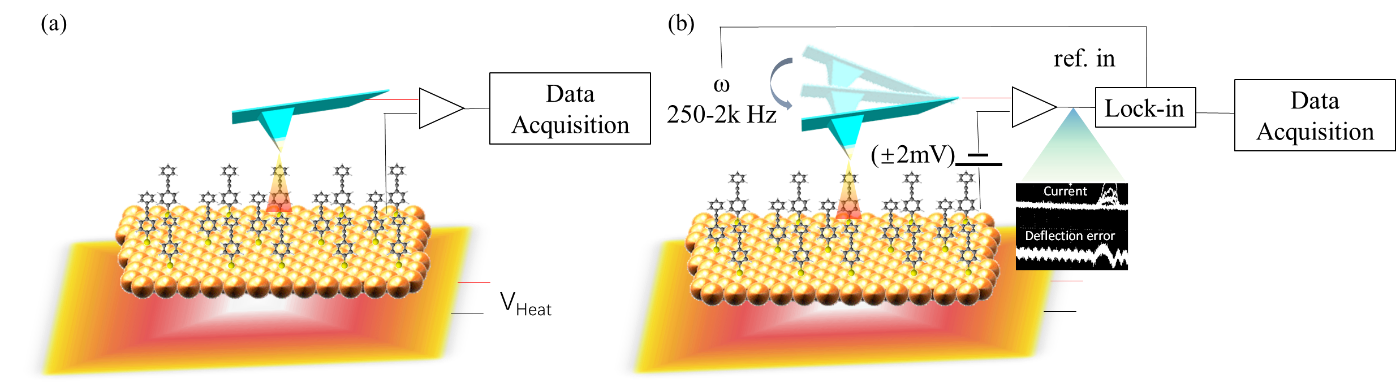
The realisation of self-assembled molecular-electronic films, whose room-temperature transport properties are controlled by quantum interference (QI), is an essential step in the scale-up of QI effects from single molecules to parallel arrays of molecules. Here I will report on our recent progress such enhanced self-assembled monolayers (SAMs). I will focus on experimental aspects of the work focusing on the key role that scanning probe microscopy takes in the characterisation of SAMs. We have used a modified thermal-electric force microscopy (TEFM) approach, which integrates the conductive-probe atomic force microscope with a sample positioned on a temperature-controlled heater, operating with a probe-sample peak-force tapping feedback that interactively limits the normal force across the molecular junctions (figure 1b).
Figure 1. Experimental setup of TEFM in (a) contact mode and (b) PFT mode. In both cases, the temperature of the sample was controlled by a Peltier stage. A function generator combined with a 10x amplifier was used to heat up and cool down the sample. A boron-doped diamond probe (tip radius < 25nm) with high thermal (~1000 Wm-1K-1)) and low electrical resistance (~1 kΩ) was used both as the thermal sink and the voltage sensor.
Recently, the effect of destructive QI (DQI) on the electrical conductance of self-assembled monolayers (SAMs) has been investigated. Here, I will show that we have demonstrated chemical control of different forms of constructive QI (CQI) in cross-plane transport through SAMs and its influence on cross-plane thermoelectricity in SAMs. It is known that the electrical conductance of single molecules can be controlled deterministically by chemically varying their connectivity to external electrodes. Here, by employing synthetic methodologies to vary the connectivity of terminal anchor groups around aromatic anthracene cores, and by forming SAMs of the resulting molecules, it can be clearly demonstrated that this signature of CQI can be translated into SAM-on-gold molecular films [1]. Furthermore, I will discuss the role that the chemical anchor of the SAM plays in the transport properties of the film [2] and how thermoelectric power harvesting can be controlled by the pressure applied to molecular junctions [3]. Finally, I will discuss the role of ‘slippery’ porphyrin anchors [4] and multilayer films and how these offer exciting design strategies for future SAMs.
- References
[1] Wang, et al. Scale-Up of Room-Temperature Constructive Quantum Interference from Single Molecules to Self-Assembled Molecular-Electronic Films, Journal of the American Chemical Society 142 (19) 8555–8560 (2020)
[2] Ismael, et al. Tuning the thermoelectrical properties of anthracene-based self-assembled monolayers, Chemical Science, 11, 6836-6841 (2020)
[3] Wang, et al. Optimised power harvesting by controlling the pressure applied to molecular junctions. Chemical Science 12 (14), 5230-5235 (2021)
[4] Wang, et al Thermoelectric properties of organic thin films enhanced by π-π stacking. Journal of Physics: Energy, 4 (2), 24002 (2022)