Automated high spatial and temporal resolution thermomechanical strain mapping in a scanning electron microscope on materials for demanding environments
- Abstract number
- 194
- Presentation Form
- Contributed Talk
- DOI
- 10.22443/rms.mmc2023.194
- Corresponding Email
- [email protected]
- Session
- EMAG - EM Data Processing & Analysis
- Authors
- Dr Albert Smith (2, 4), Dr David Lunt (3, 4), Dr Allan Harte (3), Dr Ben Poole (3), Fabrice Martinez (1), Dr Ed Pickering (4), Dr Jack Donoghue (4)
- Affiliations
-
1. NewTec Scientific
2. TESCAN-UK
3. UKAEA
4. University of Manchester
- Keywords
automation insitu thermomechanical-testing HRDIC fusion-materials
- Abstract text
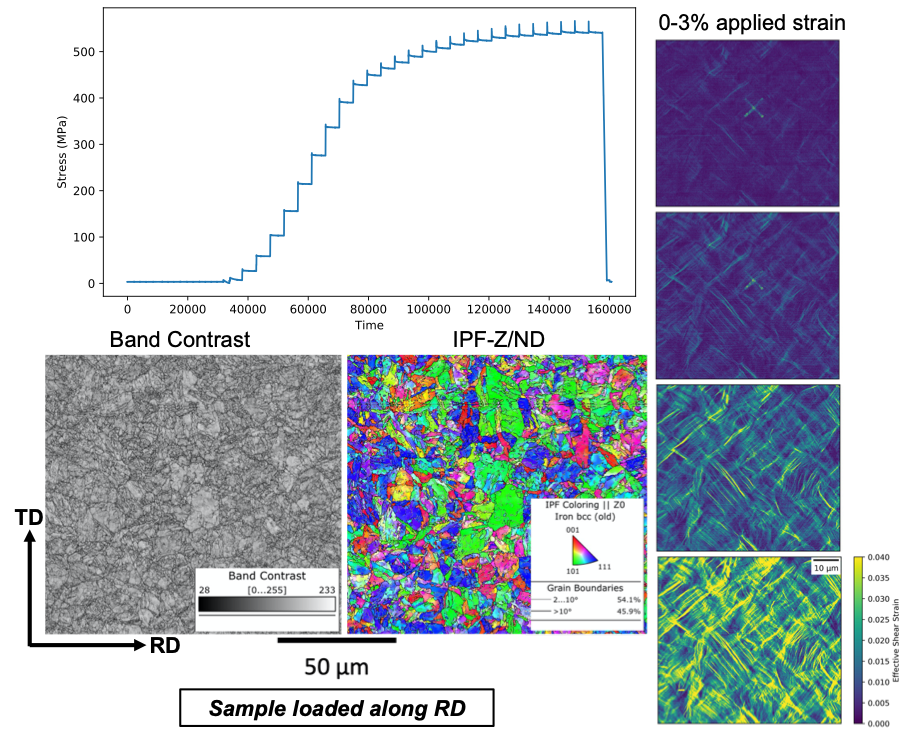
Materials for demanding, high temperature environments are subjected to harsh thermomechanical conditions where the mechanisms of failure are typically microstructurally driven. Hence, insitu mechanical testing along with measuring strain at the sub-grain scale level is increasingly being used to evaluate the micromechanical mechanisms of materials for both energy and transport applications, linking the plasticity to the underlying microstructure (Figure 1). In this study, automated data collection along with both orientation and high-resolution strain mapping have been applied to study fusion relevant materials under load and temperature conditions representative of in-service environments.
Typically, performing statistically relevant in situ testing is a labour-intensive process, consisting of incrementing the load, re-acquiring and re-focusing the field of view and imaging the region, which is severely limited by working hours. Here, we show the development of a fully-automated insitu thermomechanical testing procedure in a scanning electron microscope; a NewTec MT1000 in a TESCAN Clara. This new facility allows the collection of high temporal resolution microstructural deformation information, that can be quantified using digital image correlation, with no impact to the spatial resolution of the measurements compared previous strain mapping studies, typically ~80 - 120 nm after processing. Strain mapping allows for the quantification of shear strain in discrete slip traces and heterogeneous deformation at the grain scale. The influence of the local microstructure on the degree of temperature dependant strain localisation has implications for damage accumulation under in-service conditions. These findings can be used for to inform both modelling predictions and materials selection.
Figure 1: An example of the underlying microstructure and an effective shear strain map with 87 nm strain resolution in a ferritic-martensitic steel.
- References