Advancing NanoSIMS analysis of carbon materials for next-generation Li-ion battery anodes
- Abstract number
- 513
- Presentation Form
- Contributed Talk
- Session
- Sustainability and Carbon Net Zero
- Authors
- Gina Greenidge (1), Greg McMahon (1), Teresa Insinna (2), Clare P Grey (2)
- Affiliations
-
1. National Physical Laboratory
2. University of Cambridge
- Abstract text
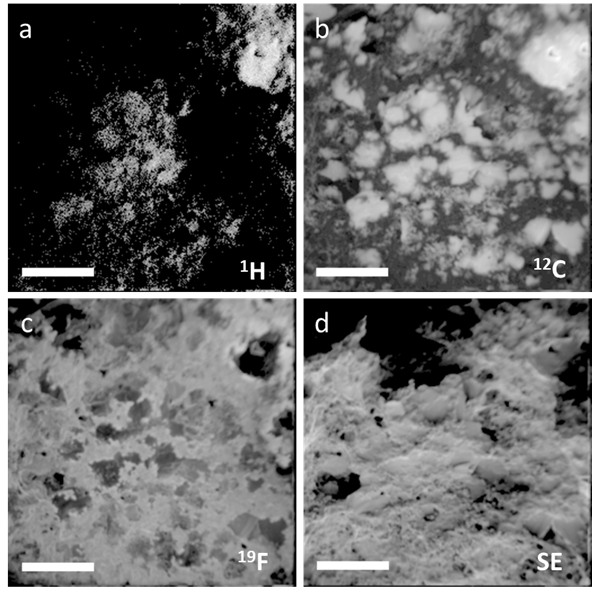
In the effort to achieve net zero greenhouse gas emission targets, lithium-ion batteries (LIBs) have generated considerable interest among researchers as a tool for energy storage. However, the devices experience gradual capacity loss and failure due to various chemical and microstructural degradation mechanisms in their different components. In this work, we introduce the use of nanoscale secondary ion mass spectrometry (NanoSIMS) imaging to investigate these degradation mechanisms in carbon-based LIB anodes. NanoSIMS boasts high-resolution isotopic imaging (< 50 nm), depth profiling capabilities, detection limits down to the ppm-ppb range and the ability to detect all elements in the periodic table including hydrogen. Here, we characterize two types of commercially available graphite anode materials in response to ageing at a cycling rate of C/20 in LP57 electrolyte. High spatial resolution SIMS images mapping the distribution of elements of interest were acquired using a Cs+ primary ion beam. Typical isotopic images are presented in Figure 1 which shows the distribution of 1H, 12C, 19F and an ion-induced secondary electron image of a pristine graphite anode (material that was not exposed to the electrolyte). Developing NanoSIMS capabilities in this field will add to the arsenal of spectrometry tools available for LIB analysis and can ultimately lead to improvements in battery performance.
Figure 1 (a-c) NanoSIMS isotopic images of pristine graphite electrode. (d) Ion-induced secondary electron (SE) image of pristine graphite. Scale bars are 5 µm.