Multimodal Analysis of Concrete and Cementitious Materials
- Abstract number
- 68
- Presentation Form
- Poster & Flash Talk
- DOI
- 10.22443/rms.mmc2023.68
- Corresponding Email
- [email protected]
- Session
- Multiscale and Correlative Microscopy Approaches to Microanalysis and Spectroscopy
- Authors
- Dr Joshua Lea (1), Dr Daniel Haspel (1), Dr Ana Blanco-Alvarez (2), Dr John Kolawole (2), Liam Whyte (2), Dr Matthew Hiscock (1)
- Affiliations
-
1. Oxford Instruments
2. School of Architecture, Building and Civil Engineering, Loughborough University
- Keywords
Concrete; cement; SEM; EDS; Raman
- Abstract text
Concrete is the most used structural material in the world however its production and use generate a significant carbon footprint.1 To combat this, more sustainable approaches are needed so that we can ensure construction meets the expectations set out by the UK government’s Net Zero Strategy. The use of alternative aggregate mixtures using additives such as magnesium oxychloride and geopolymers provide environmentally friendly options, but additives can have a profound impact on the overall bulk material properties.2 Understanding and examining the chemistry within a novel cement mixture provides us with an insight into the optimal ratios of the substituent parts, therefore giving us greener methods of construction without sacrificing strength or durability.
Correlative EDS (Energy Dispersive X-ray Spectrometry) and Raman spectroscopy inside a scanning electron microscope is a powerful combination for this purpose. EDS utilises the electron beam to induce the emission of X-rays that have a characteristic energy corresponding to the atom from which they originated thereby allowing identification of elements. Raman spectroscopy is the inelastic scattering of light that provides us with a chemical fingerprint, allowing us to distinguish the individual chemical and mineral components within the mixture by their molecular structure. When used in combination, both techniques can provide us with complimentary, highly detailed information of the internal structure.
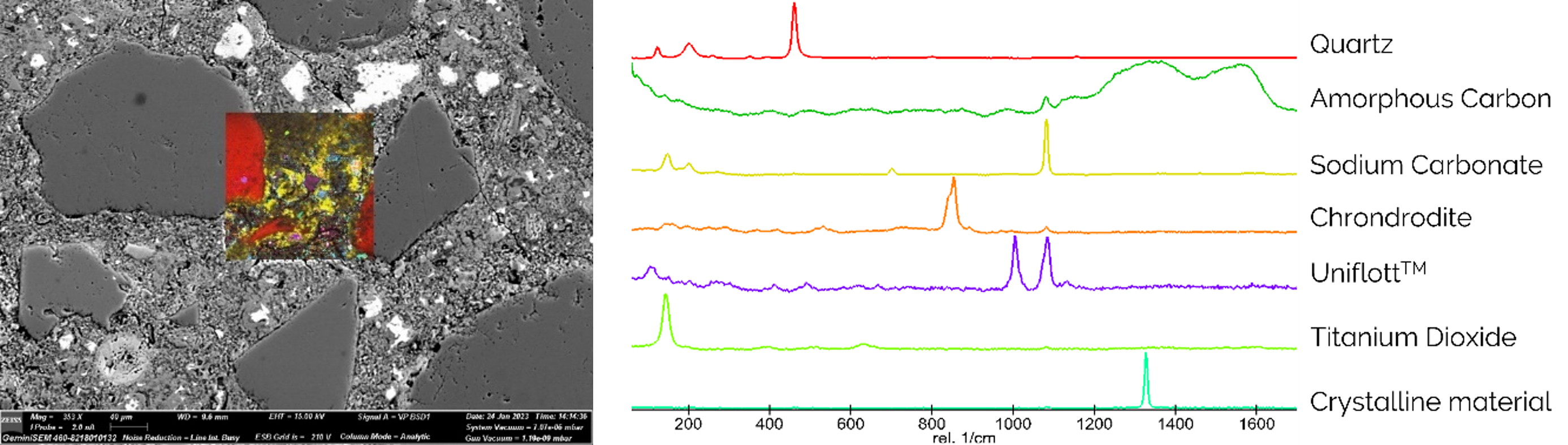
Here we present an analytical workflow that combines the power of both optical and electron microscopy to provide us with a refined understanding of the bulk material at a microscopic level. Using the Oxford Instruments AZtecFeature software package, we can conduct rapid EDS feature analysis and classify specific components.3 We can then use targeted Raman chemical analysis using the Oxford Instruments WITec RISE (Raman in SEM) system to identify specific molecular species and compare them to Raman spectral databases.4 From this, we obtain elemental distribution and quantification with focused chemical identification meaning we can confidently distinguish the components in our material, as shown in figure 1. This allows to compare how subtle changes in the chemical composition contributes to the overall properties of the material.
Figure 1 - The overlaid Raman spectral map on the backscatter electron image of common concrete with the accompanying Raman spectra of the individual components. Obtained with the WITec RISE system coupled to a Zeiss Gemini460 SEM, sample excited with a 532 nm laser.
- References
- C. R. Gagg, Engineering Failure Analysis, 2014, 40, 114–140.
- N. Mohamad, K. Muthusamy, R. Embong, A. Kusbiantoro and M. H. Hashim, Materials Today: Proceedings, 2022, 48, 741–746.
- C. Lang, M. Hiscock, J. Holland, S. Yamaguchi, D. Joyce and G. Vatougia, Microscopy and Microanalysis, 2015, 21, 337-338
- J. Toporski, T. Dieing and O. Hollricher, Confocal Raman Microscopy, Springer, Cham, Switzerland, 2018.