An investigation of plasmon dispersion in topological insulator Bi2Se3 using momentum-resolved electron energy loss spectroscopy.
- Abstract number
- 326
- Presentation Form
- Poster & Flash Talk
- DOI
- 10.22443/rms.mmc2023.326
- Corresponding Email
- [email protected]
- Session
- Poster Session Two
- Authors
- Mairi McCauley (3), Timothy Moorsom (1), Quentin Ramasse (4), Demie Kepaptsoglou (4), Matthew Rogers (2), Craig Knox (2), Donald MacLaren (3)
- Affiliations
-
1. School of Chemical and Process Engineering, University of Leeds
2. School of Physics and Astronomy, University of Leeds
3. SUPA, School of Physics and Astronomy, University of Glasgow
4. SuperSTEM Laboratory, SciTech Daresbury Campus
- Abstract text
Topological insulators such as Bi2Se3 are of interest in plasmonics due to the high conduction electron mobility and spin polarisation expected to be supported by their protected surface electronic states. These topological surface states (TSS), which are independent of film thickness, are formed due to strong spin orbit coupling which leads to band inversion in the bulk. As a result, electrons in these states, known as Dirac electrons, are confined to the 2D surface with reduced scattering [1]. Plasmonic excitations of the Dirac electrons could provide a means of low-loss transport for plasmonic devices if the TSS can be controlled. Use of adsorbates, dopants and thin film coatings has been proposed to manipulate the band structure and plasmon characteristics. This research focusses on the use of organic layers, such as C60, towards that goal.
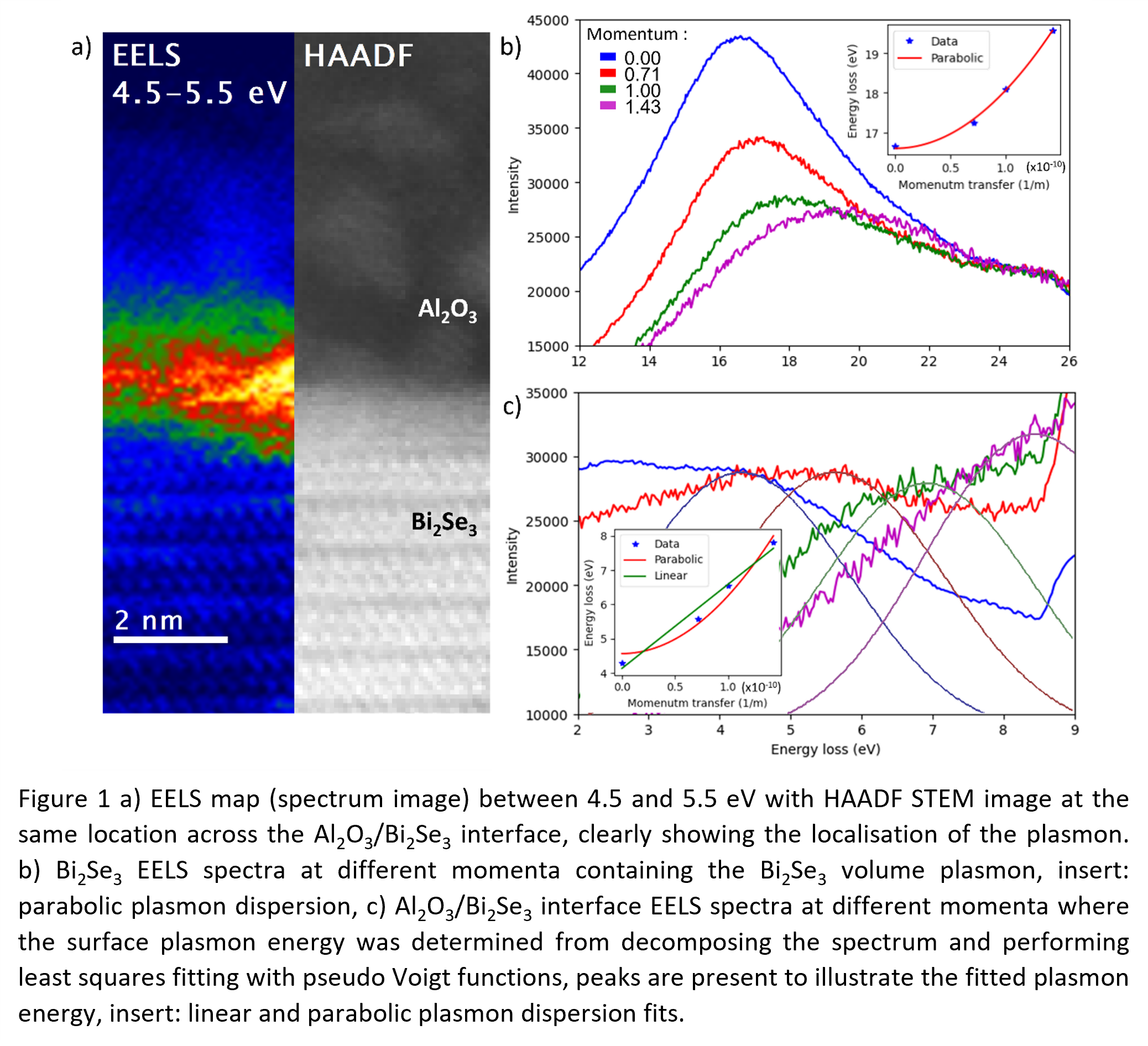
To observe if the TSS are modulated by the adsorption of C60, electron energy loss spectroscopy (EELS) was used to excite plasmons in the bulk and at the interfaces of Al2O3/Bi2Se3/C60 films. A key benefit to this technique is the ability to observe the localisation of plasmons [2]. Within the bulk of Bi2Se3 a volume plasmon was identified at 17.3 eV and within 4 nm of the Al2O3/Bi2Se3 interface a surface plasmon was observed at 5 eV, as shown in the spectrum image in figure 1a. The presence of the surface plasmon at this energy confirms that the surface states remain intact and are not significantly altered by the presence of Al2O3. At the Bi2Se3/C60 interface additional peaks are present between 4 and 6 eV due to interband transitions in the C60 which could disguise the surface plasmon at this interface.
To determine whether the surface plasmon was due to oscillations of Dirac electrons, the plasmon dispersion was mapped using momentum-resolved EELS [3]. This technique makes use of a small collection angle to select electrons within a particular momentum range to contribute to an EELS spectrum. The EELS aperture is displaced along a high symmetry axis of the Brillouin zone to collect EELS spectra at different momenta and the plasmon energies (E) are plotted against the momentum change (k). Bulk plasmons tend to exhibit a parabolic trend in an E vs. k plot, whereas for Dirac electrons a linear trend is predicted. The plasmon dispersion of the 17.3 eV Bi2Se3 volume plasmon is presented in figure 1b and follows the expected parabolic trend. Figure 1c displays the plasmon dispersion of the 5 eV surface plasmon at the Al2O3/Bi2Se3 interface. Fitting of this dispersion with a linear trendline is slightly better than parabolic. The presence of interband transitions at the Bi2Se3/C60 interface complicates the mapping of plasmon dispersion as the peaks are observed to disperse at different rates. Numerical simulations of the interfacial EELS spectra and plasmon dispersion were carried out using a finite element method to better understand these results [4].
Current results indicate there may be changes induced in the TSS states by the C60 interface, however, as yet interband transitions mask the key peaks and make fitting difficult. We will explore a range of different molecules to tune the positions of the inter-band transitions to allow improved fitting.
- References
[1] Moore J E 2010 Nature 464 194–8
[2] Liou S C, et al. 2013 Physical Review B - Condensed Matter and Materials Physics 87(8) 085126
[3] Hage F S, et al. 2013 Physical Review B - Condensed Matter and Materials Physics 88(15) 155408
[4] Konečná, A., et al. 2018 Physical Review B, 98(20) 205409