Anti Curtaining Table for generating smooth cross sections in inhomogeneous materials
- Abstract number
- 8
- Presentation Form
- Poster
- DOI
- 10.22443/rms.mmc2023.8
- Corresponding Email
- [email protected]
- Session
- Poster Session One
- Authors
- Dr. Andrew Jonathan Smith (1), Klaus Schock (1), Dr. Stephan Kleindiek (1)
- Affiliations
-
1. Kleindiek Nanotechnik
- Keywords
FIB, PFIB, curtaining, rocking stage
- Abstract text
When milling materials using Focussed Ion Beam (FIB) microscopes - especially when using plasma FIBs (pfIBs), rough surfaces can result if the milled materials exhibit inhomogeneities or other features that affect how the ion beam interacts with the material.
At the same time, it is desirable to achieve smooth surfaces e.g. for subsequent analyses or when manufacturing TEM slices with uniform thicknesses.
The best way to counteract this non-uniform milling that results in so-called 'curtaining' on the exposed surface, is to periodically change the angle at which the focussed ion beam impinges on the sample surface by rotating the sample a few tens of degrees along an axis that is perpendicular to the cross sectional surface being generated [1].
In this work, the rotation is performed using a specialized substage that allows positioning the Region of Interest (ROI) on the axis of rotation - resulting in eucentric rotation about the ROI.
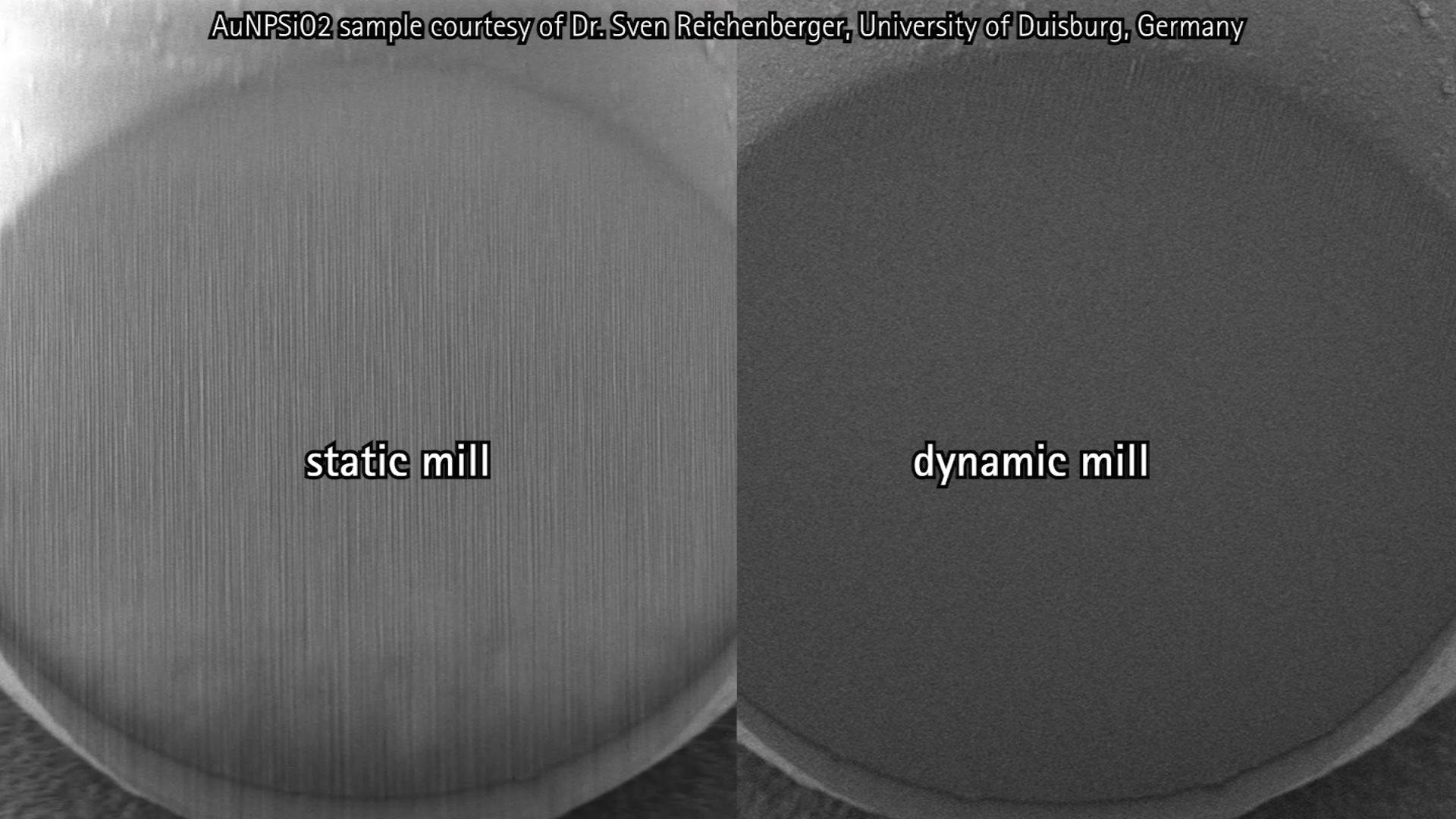
This back & forth rotation or 'rocking' of the sample can be done in two modes: In static mode, the sample is rotated by (e.g.) +20° and a milling step is executed resulting in a corrugated surface due to the effects described above. Next, the sample is rotated by -40° (i.e. to an angle of -20°) and another milling step is initiated. This milling step can be stopped as soon as the 'curtains' have disappeared, resulting in a smooth surface.
In dynamic mode, the sample is continuously rotated along its eucentric axis - alternating between two end-points (e.g. ±20°) while the ion beam is used to mill the surface.
Both methods yield smooth surfaces suitable for further investigation or processing. The images below show an example FIB milled cross section.
Fig. 1: Left, standard milling without rocking. Right, dynamic milling with simultaneous sample rocking while the focussed ion beam is used to cut into the material.
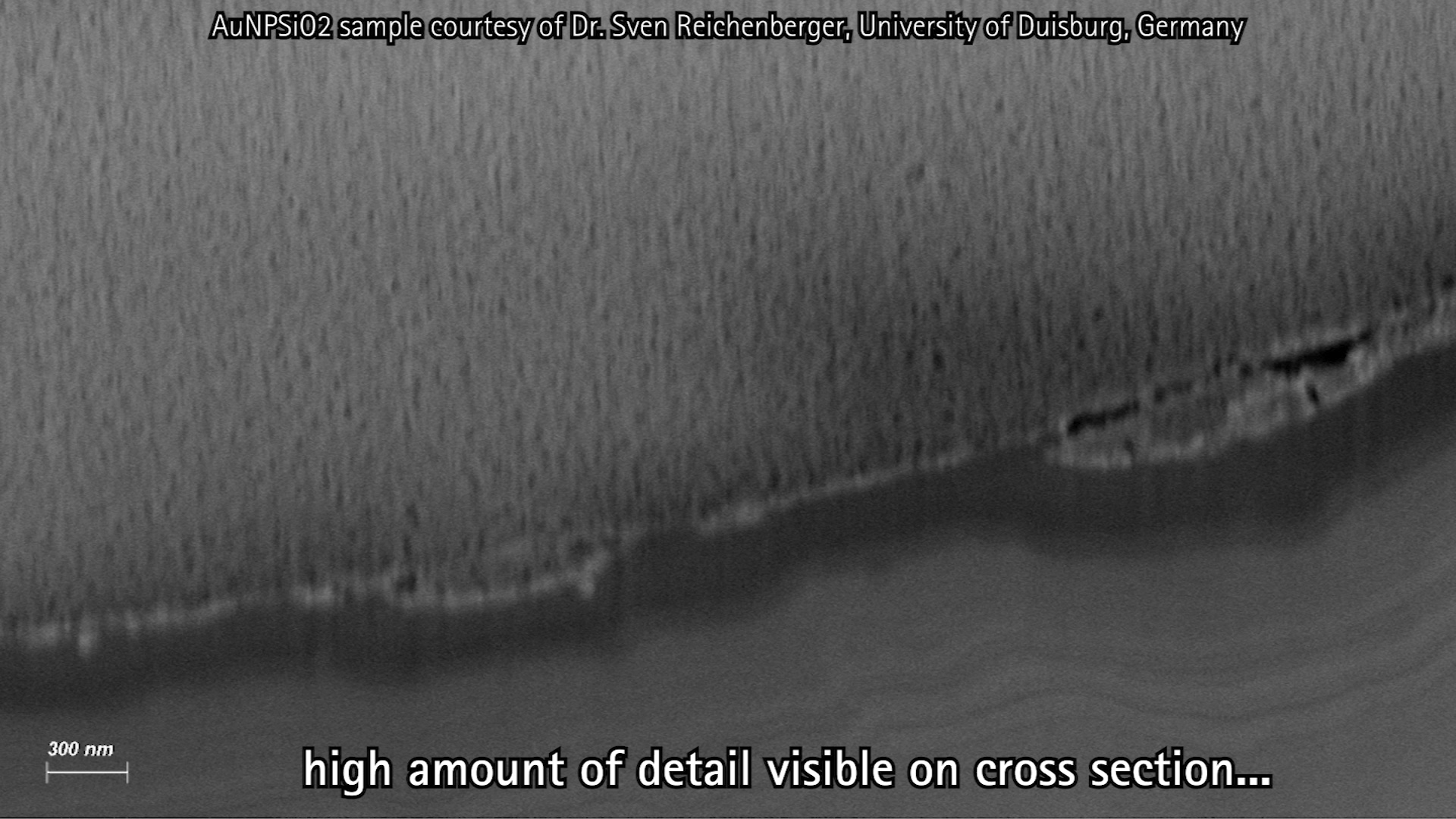
Fig. 2: Close-up of the interface between the sample's core and shell materials. This interface is not discernable when the curtaining artefacts are present.
- References
[1] Loeber et al., J. Vac. Sci. Technol. B 35(6), Nov/Dec 2017